Category Archives: Skill development

The Future of Work

When you are thinking about the direction of your career in the future it’s always worth considering your options in the context of a changing world.  There has been a lot of research, and many reports written, on the future of work.  If you haven’t read anything on this topic then why not get started by dipping in to the information below?  As you would expect there is a lot on the impact of technology on the type of jobs that will be available, and those that are likely to disappear.

McKinsey Global Institute podcast on the future of work

Deloitte reports on the future of work

Future of work: jobs and skills in 2030

Identifying professional development opportunities

If you are looking for opportunities to support your personal, professional or academic development we have a new online platform that can  help – MyDevelopmentHub.  It brings many of the opportunities available across the University together into one searchable platform.  Whether you want to improve your influencing skills or are interested in learning how you can work more effectively in a team, there are resources to support you.  Although it also lists on campus opportunities to develop, many of the resources are available online so can be accessed by students studying by distance learning.

At the moment we’ve launched a beta version so we’re still developing the platform but it’s already a really useful tool.  Have a look and do tell us what you think!

MyDevelopmentHub

Effective group working

There was an interesting article in the Times Higher Education journal this week.  It talked about research Google did a few years ago on what the main characteristic was for a successful team.  It concluded:

The crucial feature of successful teams was kindness: members of the outstanding teams were vigilant in taking care of each other, and those groups were the most innovative, productive and happy.

The article went on to talk about how universities can support students to develop approaches to group working that will help them to be more effective.  Not only can this help with success during your studies, but as Google’s research has shown it is valued by employers.  In particular, for online students from countries across the world, building compassion into group working approaches can help build connections and encourage critical thinking – a key skill for successful postgraduate study.

I’ll let you read the article and research yourself and encourage you to consider how you could modify your approach to aid success.

Times Higher article on team working

Google’s team effectiveness research

Get comfortable with giving feedback

My colleague Jo Fairweather has written this post on how to give effective feedback.  Giving feedback is an important part of being a good colleague or line manager, and this post will also help you to reflect on what you want when you are asking others to give you feedback on your work.

We regularly give feedback in our lives. It could be writing a review on TripAdvisor, commenting on a colleague’s email or giving feedback on someone’s essay.

Considering your approach to giving feedback can help make you and the person who receives feedback feel more comfortable.

Reflect on your current approach to giving feedback. Are you on target, go in with a sledgehammer or avoid the issue for fear of upsetting the individual? The purpose of providing feedback is for the recipient to benefit from that new knowledge. Giving feedback is not about trying to change that person, be judgemental, or make them like you. Being aware of your natural response can help you analyse how you view feedback.

Be clear on what the feedback relates to. Be descriptive not interpretative. Feedback is like holding up a mirror to someone else. Try to keep personal opinions and concerns out of the message. Emphasise the “what” and “how” rather than the “why.”

Present a balanced view. Pay attention to giving both positive and negative feedback. Most people listen out for and remember negative feedback received first so a good balance is important.

Put yourself in the other person’s place. Assess the readiness of the other person to make use of what you say. Pick your time and place. Consider if the feedback will be given face to face. Receiving feedback via text, email, or phone can affect the tone and lead to misinterpretation.

Be specific rather than general. Stick to concrete examples you have noticed and be aware of getting side tracked by unrelated matters. For example, if you are being asked to comment on the tone of an email don’t start commenting on the spelling too.

Be direct and courageous. You may feel uncomfortable saying something unpleasant to the person. Remember your intention is to be helpful. Keeping information from the person can be more harmful than telling them.

Say your information and let it go. It is up to the person what they do with your feedback, don’t be offended if they don’t take it.

By following the above principles you will become more comfortable in giving feedback.

Annual reviews in employment: how to get the most of out them

Annual review, performance review, appraisal, or some other name. Whatever they are called, they are typically a yearly meeting, usually between an employee and their line manager, to reflect on the employee’s progress within their job within the previous year and to set objectives for the following year. Many of our distance learning students are working full-time while studying so will probably encounter annual reviews.

In many organisations the annual review is performance-related and linked to salary so there’s some pressure to do well. But for everyone, the review is an opportunity to reflect on what’s gone well over the year, what hasn’t gone well and why, to consider where you want to go with your role in the future, and what training or development support would help you succeed in your role. The review can be used to support your long term career development goals if you prepare for it well and approach it properly.

  • Set your work objectives for the year but ask for opportunities to gain experience in areas that interest you. Think about skills you want to develop or improve and what work opportunities may give you a chance to do this. Think about how this could help meet specific business objectives as well as your own interests as you will present a more persuasive argument.
  • Is your current course of study related in any way to your job? If yes, make sure you talk about what you are learning and how it has influenced (positively I hope!) your work. Have you developed new knowledge or skills that you could share with your reviewer and suggest ways you could use them in your current role, to broaden your experience and benefit your employer at the same time.
  • Be open to constructive feedback on your performance. Ask for suggestions about what you could do better, and what support may be available to help you do this. Discuss possible solutions to barriers you have faced in your role. Use this as an opportunity to get guidance rather than being defensive about any negative comments or work issues.
  • What training could be useful to help you do your job and progress? It’s worth identifying suitable training opportunities before your review and discussing them with your reviewer, again thinking about how this training could help you contribute more effectively to set objectives.

If you prepare effectively for your review, and engage positively with the process you will hopefully have a productive, developmental conversation which will help you move forward in your career.

Do positive role models increase public speaking confidence?

confidenceThere is some interesting research about role models and public speaking confidence that I want to share.  In particular, an article entitled Successful female leaders empower women’s behavior in leadership tasks* (and any male readers bear with me because this isn’t just for female students).

A sample of 149 male and female students were asked to give a speech in a virtual reality environment.  During their speech they were exposed to a picture of Hillary Clinton, Angela Merkel or Bill Clinton.  The length and perceived quality of the speeches were measured to give an indication of behaviour in a stressful leadership task.  The essence of the research findings were:

  • Female students spoke for less time than men when a picture of Bill Clinton or no picture was used
  • But female students spoke for longer and rated their presentations more highly when speaking in the presence of a picture of a female role model, speaking for similar times to male students
  • There was no significant effect of any role model on the speech length or rating of male students
  • They concluded that subtle exposure to successful female leaders inspired women’s behaviour in stressful leadership tasks.

Putting aside your views on how good these political figures are as role models (and there was a lot of interesting / funny debate on this on another post about this I read somewhere!) I wondered what you thought about this?  What factors influence your confidence when giving presentations (and you can extend this to presenting yourself at interview, having difficult conversations in a work or academic context…)?

At the conference where I came across this research, Dame Sally Davies (Chief Medical Officer, the UK government’s principal medical adviser) said she imagines winding herself up before going into difficult meetings.  A senior member of staff in College of Medicine and Veterinary Medicine mentioned she always makes sure she wears a jacket (and applies some lipstick!) before important presentations.  We’ve written about power poses before and how these can increase confidence levels.

So what works for you?  It would be great if you could share your tips for increasing confidence (and decreasing nerves) before presentations or difficult conversations in the comments below.

* Ioana M. Latu at al Journal of Experimental Social Psychology Volume 49, Issue 3, May 2013, pages 444 – 448. (You can get access to the full text through the library e-journals).

Leadership skills … lessons from business leaders.

Leadership skills are a key requirement for many professional careers … but what makes a good leader?

I came across an interesting article “10 leadership lessons from the world’s biggest business leaders” by Raj Tulsiani,  in the journal Recruitment Grapevine (December 2015).  Raj cites adaptation as the key to success, along with learning from your peers and those who have been there and done it already.  With this in mind he presents one piece of advice from 10 global business leaders. A summary of this advice follows below:

  1. Look at the big picture:  Think deeper and rather than focussing on the day-to-day issues look at the bigger picture. (Bill Gates, co-founder and former CEO Microsoft)
  2. Be passionate:  If you do something you are passionate about, you are naturally going to succeed. (Mary Barra, CEO General Motors)
  3.  Create valuable networks:  Surround yourself with only positive people who are going to lift you higher. (Oprah Wimfrey,  talk show host and business woman)
  4. Find Focus:  Focus on consumers and professionals. (Steve Jobs, co-founder and former CEO Apple)
  5. Hire Smart: You don’t need another you! Creating a diverse team with people from different backgrounds can give you  a well-rounded approach when it comes to decision making. (Claire Watts, CEO QVC)
  6. Inspire your staff:  Leadership is the ability to inspire others. (Jeff Weine, CEO LinkedIn). Jeff is said to inspire his staff by encouraging them to take time out from their work everyday just to think!
  7. Listen: Lead by listening – to be a good leader you have to be a great listener.(Sir Richard Branson, founder and CEO Virgin)
  8. Never give up:  Even when the going gets really tough – never give up! (Anne Mulcahy former CEO Xerox)
  9. Be compassionate:  Show you care. If your team think you don’t care, it can be a rocky road. (John Shilifske, CEO Northwestern Mutual)
  10. Embrace change: It can be hard for business to keep up with the scale of changing products and services … but what’s dangerous is not to evolve. (Jeff Bezos, CEO Amazon)

The original article by Raj Tulsiani, CEO and co-founder of Green Park Interim and  Executive Search, can be found on Recruitment Grapevine, December 2015, p40/41, via the following link:  Recruitment Grapevine

Managing your postgraduate journey

Studying for a postgraduate award through online learning allows a lot of flexibility but most students are balancing their studies with other commitments such as work or family.  As a result we find that students often report their studies as a very intensive time and welcome support that will enable them to engage with their studies more effectively (and in a time efficient way!).

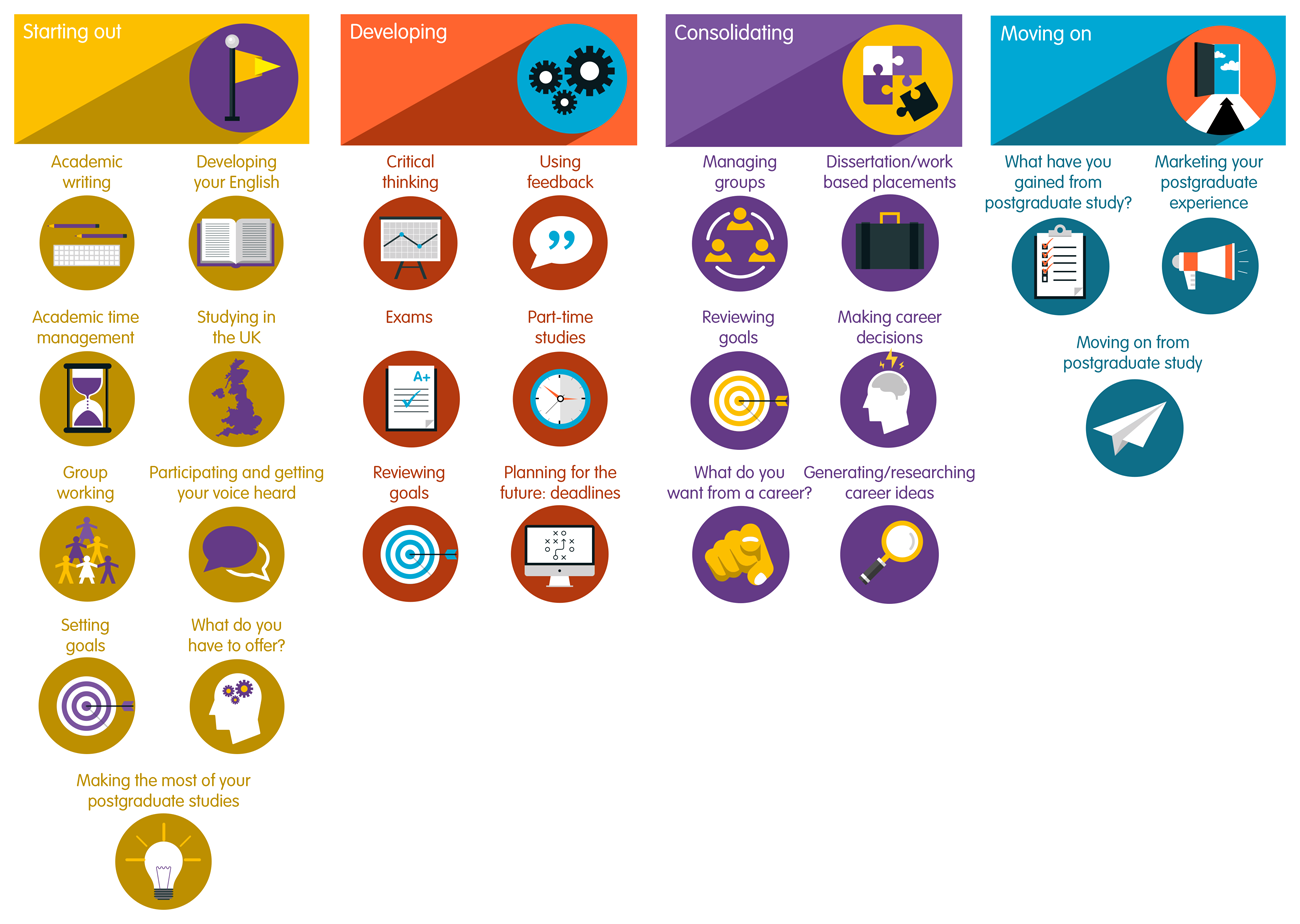
The Careers Service and the Institute of Academic Development have developed a new resource, Supporting taught postgraduates, to help taught postgraduate students to engage quickly and effectively with their studies. The resources provide support during your programme to help you to achieve academically, and take opportunities for career enhancement, and to support you to make and realise successful career decisions.  It pulls together a lot of information that is scattered around other parts of the University website and ensures it is directly relevant for postgraduate students.  Covering topics such as academic writing, time management, critical thinking, and career planning, we hope it will be of use to you as you continue your studies at the University.

You can get an overview of the topics covered in the image below or go directly to the website.

Supporting taught postgraduates

Overview03